The 3x4 Method:
A Case Study of Merit Aid (West)
Here are two examples of students from a recent cohort who used the 3x4 method (i.e. 3 school sizes across 4 geographic regions) to build their application and matching portfolio. Both of these students reside in Washington and were clients in the summer of 2025. The merit aid data referenced below is accurate as of May 2026. There’s an analysis of each student’s overall strategy below as well. Note the 3x4 method is effective for both acceptances and merit awards.
Each of these students applied the 3×4 method, but only one of the students (Nate) followed through with applications across 4 regions. The maps and tables reflect their actual application portfolios not every school they considered.
Two Final Application Lists (West)
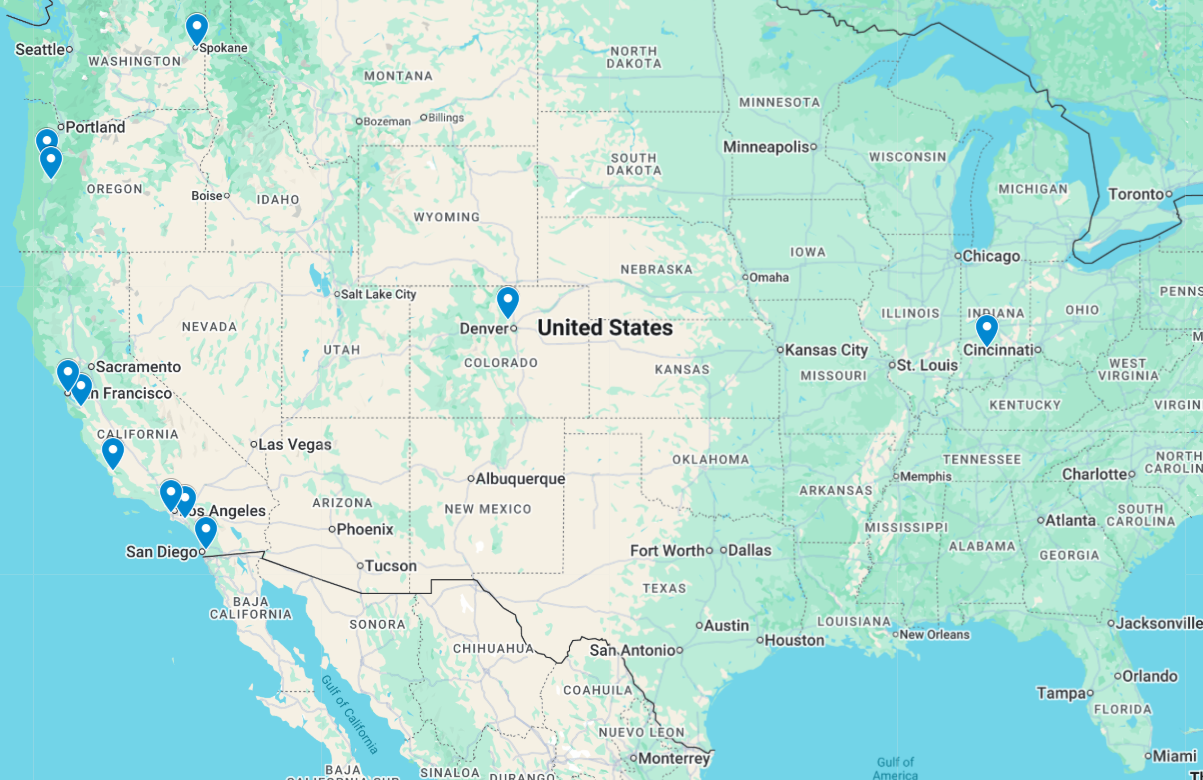
Alice’s national map of applications
Nate, like Ella in Case Study 1, went into his overall application process with a firm idea for his major: marine biology or oceanography. This focus contextualizes applications for Oregon State, Oregon, U. of Wash., U. of Alaska, U. of Rhode Island, and all the California public schools, as these universities offer programs in his chosen major. Nate, then, made complementary applications to Reed and Bates in order to include small schools among his regional patterns. Note: while California is not technically one of the regions for my 3×4 system, it is in practice, with 32 public campuses, a “region” unto itself. Nate, like Alice, wanted to consider California separate from the rest of the West.
PACIFIC NORTHWEST
Oregon State
Reed College
University of Alaska
University of Oregon
University of Washington
CALIFORNIA
Cal. State/Monterey Bay
University of California/Davis
University of California/San Diego
University of California/Santa Barbara
University of California/Santa Cruz
EAST COAST
Bates College
University of Georgia
University of Rhode Island
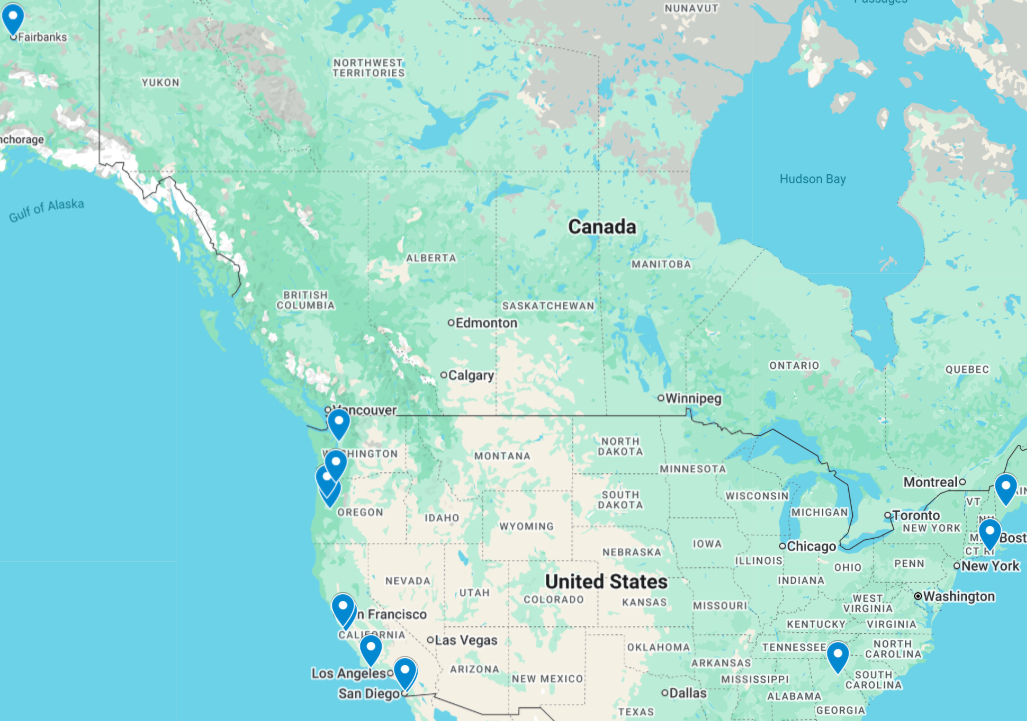
Nate’s national map of applications
Alice
Alice insisted she wanted to attend school in a warm climate hence her primary focus on California. Her West cluster features Gonzaga as a strong medium sized choice to complement three large public schools. U. of Co./Boulder is a frequent application among her high school peers, and the two big publics in Oregon pair well with this school that is further afield. Based on the comparisons among large publics in the West, Alice wanted to choose a similar large public in the Midwest, and she decided on Indiana University. Finally, seeking a temperate climate first and foremost, she balanced one small and three mid-sized private schools with two large publics in sunny Cali. Note: while California is not technically one of the regions for my 3×4 system, it is in practice, with 32 public campuses, a “region” unto itself. For Alice’s portfolio we did consider California separate from the rest of the West, especially given its two distinct applications (UC & CSU) and distinct deadlines.
WEST
Gonzaga
Oregon State
University of Colorado/Boulder
University of Oregon
CALIFORNIA
Cal Poly San Luis Obispo
Chapman
Loyola Marymount
San Diego State University
Santa Clara
University of San Francisco
MIDWEST
Indiana University
Nate
An Analysis of Merit Aid Received
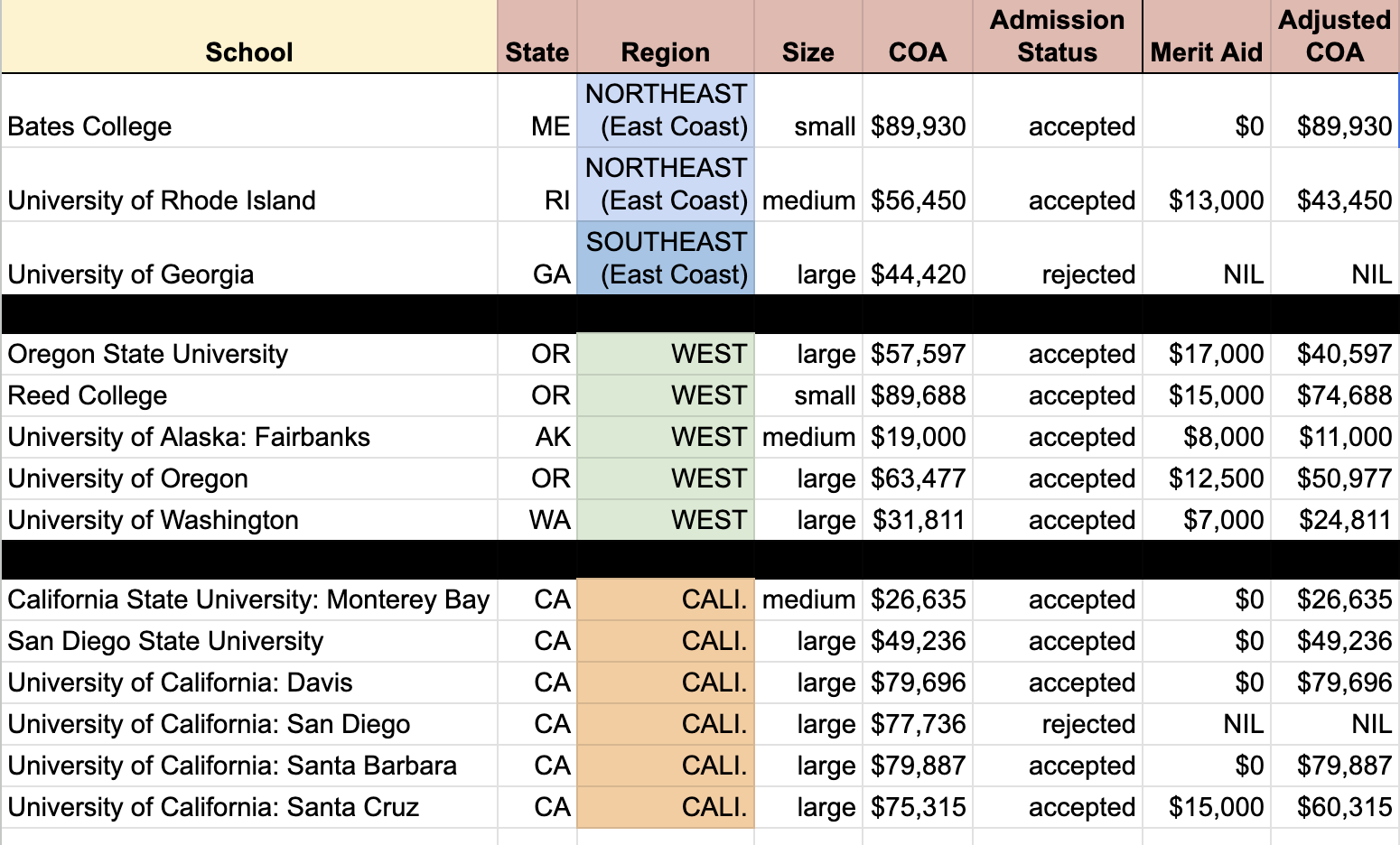
Now consider the value of the small, private school applications in Nate’s application portfolio. Bates College interested Nate with its location in Maine and its highly reputable environmental science program — a field of study related to oceanography. Bates is also prestigious (with a 13% acceptance rate), and Nate wanted this challenge in his applications. He’s pleased with the Bates acceptance, but was disappointed in the lack of a merit offer.
On the other hand, Reed, much closer to home than Bates, also offers environmental studies, and Nate was impressed with their field study program in Turks and Caicos. Reed, nearly as prestigious as Bates, clearly wants Nate to attend, as evidenced by their $15,000 offer for merit aid. This generosity does not reduce the COA competitively with respect to the Oregon or Washington public choices, but it would reduce the price of Reed to below that of UC: Davis or UC: Santa Barbara.
Finally, speaking of “signaling interest” — take a closer look at the differences between Oregon State and Oregon and UC: Santa Cruz and the other publics in Cali. Oregon State knows Nate is a strong candidate for admission to Oregon (where he did in fact get accepted). OSU signals their interest for Nate in an offer so generous it undercuts their direct competitor, Oregon, by more than $10,000.
Nate
First let’s look at Nate’s big public choices. As mentioned above, he focused on universities with marine biology/oceanography programs. All of the large publics, including all of the Cali. schools, have Nate’s desired major. Setting aside Cali. for the moment, notice just how close the cost is between Oregon State and Rhode Island. Also, notice how inexpensive Alaska is. As a resident of Washington, Nate benefits from the Western Undergraduate Exchange (WUE), an interstate, tuition pricing agreement among member states, capping out-of-state tuition at 150% of resident tuition. A WUE discount explains the significantly low cost of Alaska.
Consider, however, the COA for Washington. Nate received $7,000 in scholarships locally without anything more than filling out a form and submitting work he had already completed during the application process. Finally for the publics, let’s look at Cali. Two takeaways are apparent: (1) the CSU system is less expensive than the CU system; (2) Nate benefited from six Cali. applications given the generous award from CU: Santa Cruz. By spreading his choices among the two public systems in Cali. and applying to multiple schools in Cali., Nate ended up with realistic options with multiple price points.
Some Takeaways:
The 3x4 strategy works for both applying and earning merit aid.
It’s OK to drop to 3 regions but don’t drop to 3 sizes. Include at least one small school.
Always apply at your regional “public flagship” for reasons of choice and price comparison.
Notice how sticker price really doesn’t matter!
This fact is often lost on parents, but the nation’s small colleges on average cover 56.3% of first-year tuition. This is essentially a business model that “pays” 56¢ for every $1.00.
Seek out the most popular schools your peers apply to; talk to your school’s college counselor for a list based on recent, local data. There are often “hidden” advantages in an application to a school that has a relationship with your high school.
These examples are specific to the choices of two students from Washington, but the same pattern can be seen across regions, especially when students cross-apply from a higher COL area to a lower COL area. (Familiar examples are IL - Southeast, NJ - Southeast, WA - Southwest.)
Alice
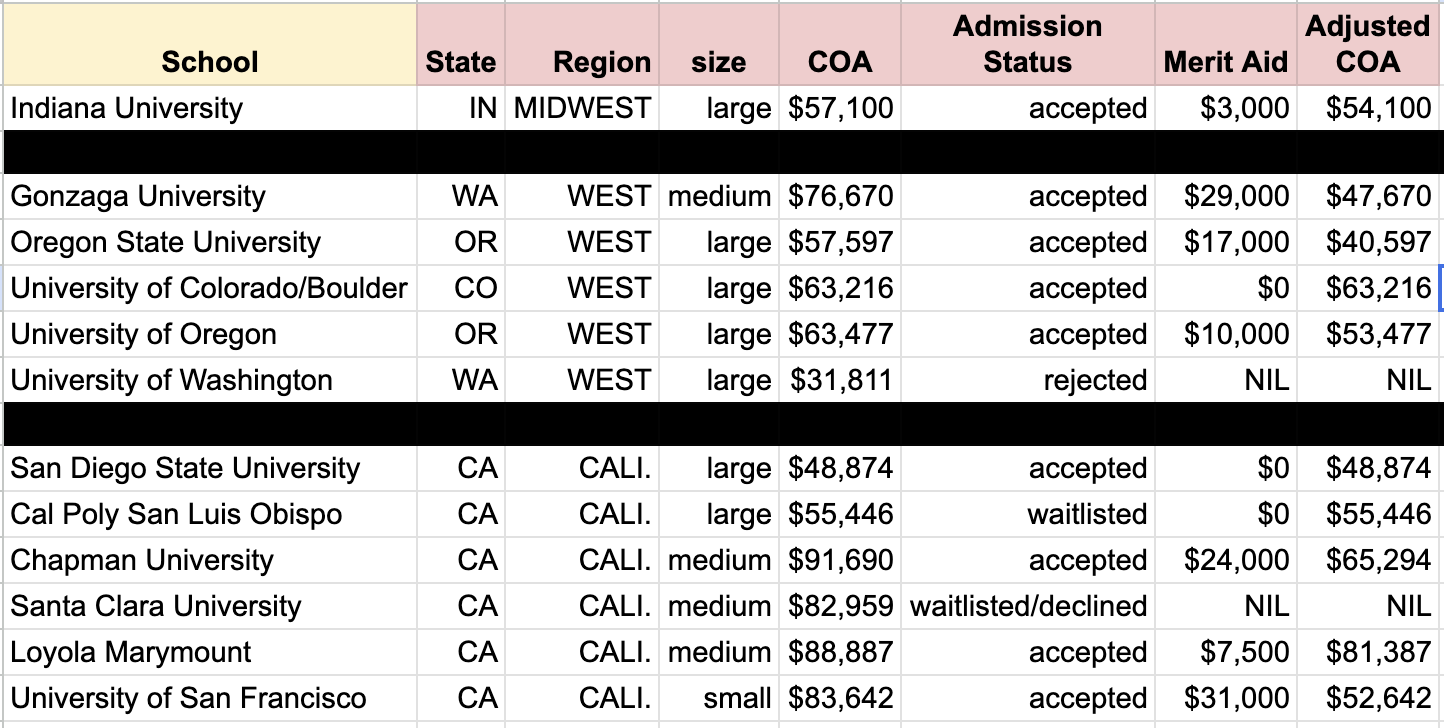
First, let’s look at the regions outside Alice’s first choice — California. Alice, at first, really only wanted to consider Washington and California and/or Southwestern schools. Her father convinced her to consider at least one mid-sized school in the West, hence the application to Gonzaga, which proved a fruitful choice. Gonzaga’s $29,000 merit aid reduced the COA below the COA for public school Oregon and below the cost of any school in California. Also, the application to Indiana merits a $3,000 award which, and this is intentional, makes Indiana competitive with Oregon, which is a peer institution.
Alice’s California strategy is masterful. Like Brianna with Tampa in Case Study 1, Alice’s high school has a “favored” university among students — Cal Poly San Luis Obispo. Cal Poly spearheaded her California choices, and Alice decided to apply to public SDSU because she felt it was a reasonable bet — SDSU is an excellent companion application for Cal Poly.
But her strategy really shines when you consider how she triangulated Chapman, Loyola Marymount, and Santa Clara. These three schools attract similar applicants, and are considered in direct competition with one another for West Coast students. While Alice decided to decline and leave the waitlist at Santa Clara, it is clear who wants her enrollment between Chapman and Loyola Marymount. Chapman’s award is so generous the attendance would be a significant $16,000 less.
Finally, there’s the singular case of the University of San Francisco — $31,000 is a major discount. This opportunity gives Alice a choice to attend a small, private school in one of America’s most beautiful cities for a COA that is competitive with large publics in less desirable locales.